november 23, 2026
more thoughts on the word "annoying"
In my previous post I focus on the decision whether to use the word "annoying". I give two examples:
1
In the context of somebody contemplating action I'd consider harmful and not ethical:
After some discussion I just told them, "Look, if you share this information with that person, I would regret speaking to you about this, and it would annoy me a lot."
2
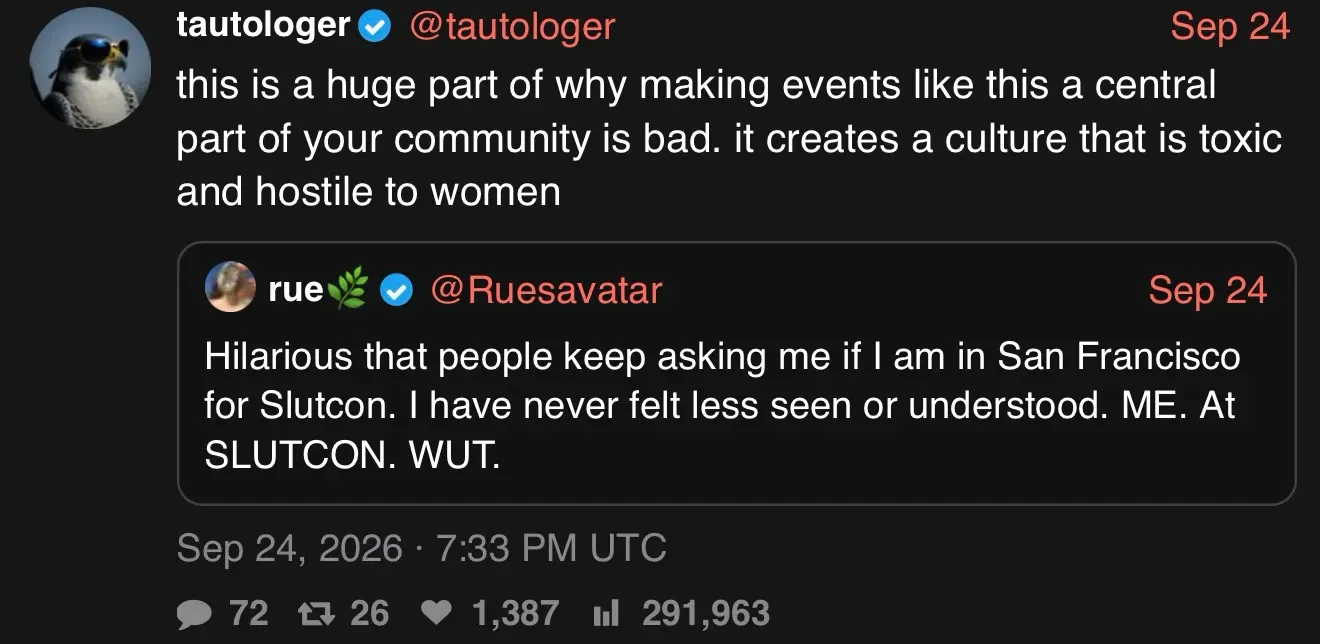
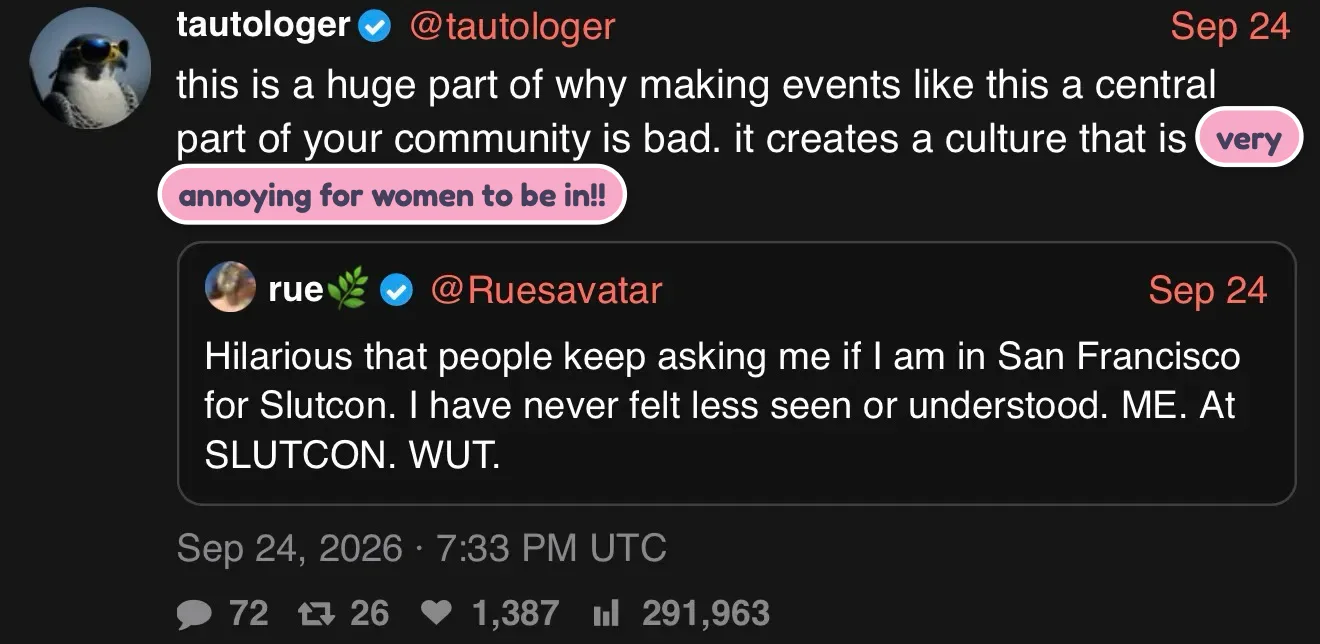
These examples do have a major difference, which is the difference between saying "this annoys/would annoy me" vs "this annoys/would annoy this class of people". This is a pretty major difference and I have commentary specific to each, but also, commentary that applies to both. I'm trying to figure out the best way to tease them apart, bear with me.
"annoying" conveys a power dynamic
The naive comparison is that using "annoying" instead of "hostile" conveys a difference in seriousness or stakes. Hostile things are worse than annoying things, so if you want to emphasize that something is harmful, call it hostile. I think this is why people reach for words other than "annoying" so frequently.
In terms of word choice's impact on actual social outcomes, I think that this severity component matters less than the power component.
When I told that community member that their contemplated actions would annoy me, I implicitly communicated that I was not scared. This was probably news to them in some sense: they were scared, and me being scared would have been normal.1 This is important! To give one framing, it is well understood in de-escalation theory that one of the most important things you can convey is that you're not afraid.2
implications on enforcement
There is an interesting slightly paradoxical trait, "annoying" can imply less severe enforcement (due to less severe harm), while also implying more probable enforcement, due to implying leverage.
There are implications as well on what enforcement will look like. Calling something annoying is itself a status attack and can declare an intent to perform further status attacks. But for the most part you can form a relatively clear picture of what's at stake.
Language that has more of an implication of victimization is not necessarily like this. You're not just stating investment in enforcement, but also a view that proportionate enforcement is not really accessible to the victim without the involvement of other parties. If that happens -- an institution or a mob gets involved -- then who knows what the stakes are! When it comes to modeling the "worst case", victims can be much scarier than sovereigns. This is all just to state the obvious, which is that tautologer's original tweet would surely inspire more fear and anxiety than my version.3
implications on litigation
If you are saying something annoys or would annoy you, that's kind of inarguable. When it comes to effecting your agenda, this is great! It's great when people can't try to thwart you via arguing, which would itself be super annoying. I love sidestepping litigation entirely.
If you are saying something is hostile to you or toxic for you, not only is this more arguable, litigation is actually forced. Often they are making an appeal to external parties (or threatening to) (or they may later do so regardless of how they feel now). So, you'd better get your litigation hat on. You can always freely apologize for being annoying, but apologizing for being aggressive is quite dangerous.
In the speaking-on-behalf-of-a-class case, saying something is for example "annoying for women" is more arguable than if you're saying it about yourself. But I think it still inspires litigation a lot less.
Aggression and harm are things with much tighter criteria and argumentative frameworks than annoyance, it's easy to build arguments around them without needing to listen to the speaker at all. Annoyingness is less threatening, giving more room for curiosity to take root where defensiveness might otherwise be. But, furthermore, arguing about annoyingness requires a lot more perspective-taking.
what if annoying is less accurate?
There is a power dynamic conveyed in addition to severity, but is that not also informative of the author's mental state? When people use language other than "annoying", are they not simply transmitting true information about feeling threatened, distressed, or powerless?
To address an even stronger potential criticism: if I suggested that women in this case replace aggression/threat verbiage with annoyance verbiage, am I not guilty of behavior eloquently described in this post:
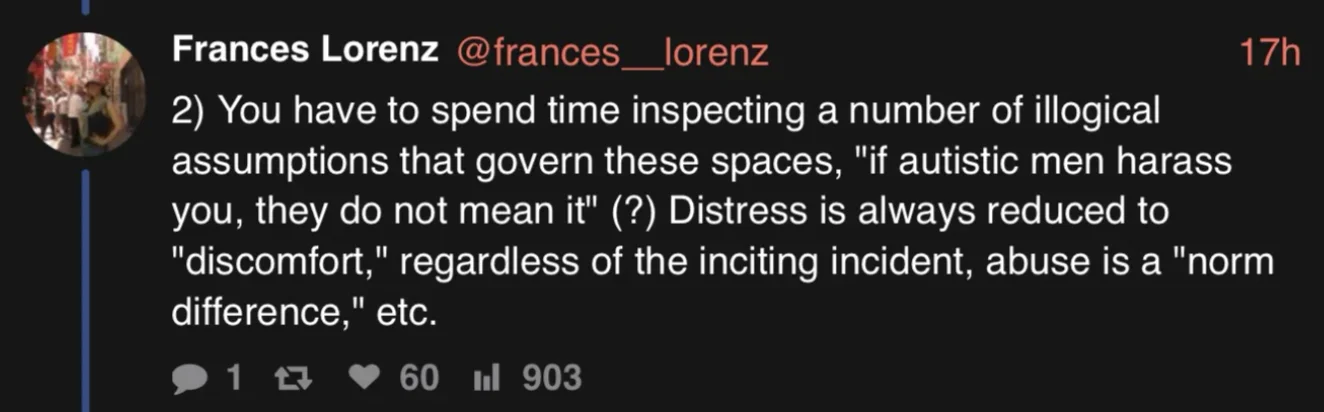
I introduced tautologer's tweet because it was a recent example that I thought was illustrative, but commentary on what tautologer's tweet should have said is outside my commentary here!
- It's really easy to get scared when a situation becomes a symbolic representation of an entire class of situations. I've done this myself many times. You're no longer (just) interacting with the individual, you're interacting with an entire social pattern or aspect of humans that is responsible for ongoing great harms. Modern humans are really good at doing this mental move.
- Hat tip Jessica Ocean for pointing this out and helping to crystallize the power dynamic component broadly
- I used to be a fairly autistic man, and related deeply to the Rationalist flirting & consent discourse I read online a decade ago. I hear the exact same things today and at every point in between, which is that men are terrified of fucking up. Many of them are terrified of overstepping and causing discomfort, and many are terrified of being ostracized. SlutCon is, textually, a response to this fear. That's not an endorsement, I just think it's important context in this particular case.
comments
no comments yet.